


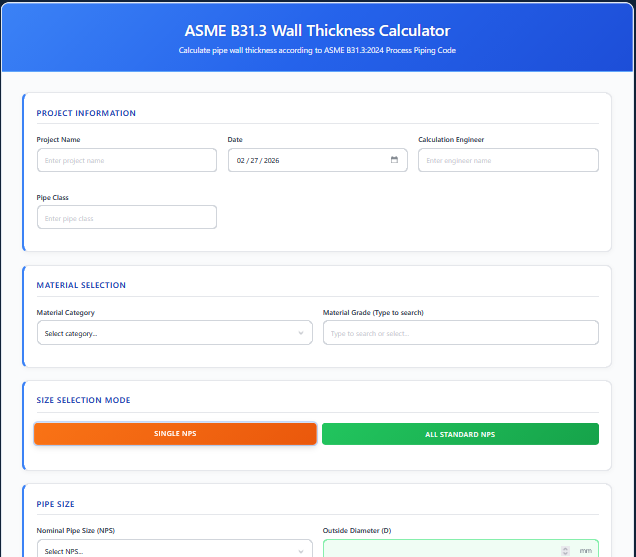
🚀 Introducing the Most Comprehensive ASME B31.3 Pipe Wall Thickness & Branch Reinforcement Calculator Available Online
Pipe wall thickness calculation per ASME B31.3 Section 304.1.2 is one of the most fundamental tasks in process piping design. Whether you are designing piping systems for oil & gas, chemical plants, refineries, or power generation, getting the minimum required thickness right — with proper consideration of corrosion, manufacturing tolerances, and weld joint factors — is critical for safety and code compliance.
Our calculator goes far beyond basic thickness calculation. It is the only online tool that combines wall thickness design per Para 304.1.2, automatic MAWP calculation, AND branch reinforcement checks per Para 304.3.3 — all in one integrated platform.
🔗 Try it now: ASME B31.3 Wall Thickness & Branch Reinforcement Calculator
How Pipe Wall Thickness Is Calculated Per ASME B31.3
The pressure design thickness for straight pipe under internal pressure is calculated using Equation 3a from ASME B31.3 Section 304.1.2:
t = P × D / [2 × (S × E × W + P × Y)]
Where:
- t = pressure design thickness (mm)
- P = internal design gauge pressure (MPa)
- D = outside diameter of pipe (mm), per ASME B36.10 or B36.19
- S = allowable stress at design temperature (MPa), from Table A-1 of ASME B31.3
- E = quality factor from Table A-1A or A-1B
- W = weld joint strength reduction factor per Para 302.3.5(e)
- Y = coefficient from Table 304.1.1, dependent on material and temperature
This formula is valid when t < D/6. Our calculator automatically verifies this condition and alerts you if special considerations per Para 304.1.2(b) are needed.
The minimum required thickness ™ is then calculated as:
tm = (t + c + m) / (1 − Mill Tolerance/100)
Where c is the corrosion/erosion allowance and m is the mechanical allowance. The calculator then selects the next higher standard wall thickness from the appropriate pipe schedule.
What Is Branch Reinforcement and Why Does It Matter?
When a branch pipe connects to a header (run) pipe, the opening in the header wall removes material that was carrying pressure loads. ASME B31.3 Section 304.3.3 requires that this lost strength be compensated through the area replacement method — ensuring that the total available reinforcement area (A₂ + A₃ + A₄) equals or exceeds the required reinforcement area (A₁).
Without adequate reinforcement, the branch connection becomes a weak point in the piping system that can lead to failure under pressure. Our calculator automates this complex check, including reinforcing pad design and weld area calculations.
⚡ Key Features That Set Us Apart
🎯 Comprehensive Material Database — 366+ Materials
Unlike other calculators that offer a handful of common materials, our tool includes the full range of ASME B31.3 Table A-1 materials:
- 5 Major Categories: Carbon Steel, Stainless Steel, Alloy Steel, Nickel Alloys, Titanium Alloys
- 366+ individual materials with complete ASTM specifications, UNS numbers, and compositions
- Temperature-dependent allowable stress values with automatic interpolation at any design temperature
- Free sample materials available to all users; full database for premium subscribers
📐 Dual ASME Pipe Standards — B36.10 & B36.19
The correct pipe dimensional standard is automatically selected based on your material:
- ASME B36.10 for Carbon Steel & Alloy Steel — Schedules 5, 10, 20, 30, 40, 60, 80, 100, 120, 140, 160, STD, XS, XXS
- ASME B36.19 for Stainless Steel, Nickel & Titanium Alloys — Schedules 5S, 10S, 40S, 80S, 160S
- Cross-standard compatibility — B36.19 materials can also access B36.10 schedules when needed for special applications
🔧 Flexible Calculation Modes
- Single NPS mode — calculate for one specific pipe size
- Range mode — calculate for all standard NPS sizes from ½” to 60″ in a single click
- Dual construction types — Seamless (E=1.0) and Welded (ERW, EFW, etc.) with automatic E-factor lookup
- Custom thickness entry — check any non-standard wall thickness
💡 Intelligent Engineering Logic
- Iterative Y-coefficient calculation per Table 304.1.1 with automatic interpolation for intermediate temperatures
- W-factor calculation per Para 302.3.5(e) — handles Carbon Steel, Cr-Mo steels, CSEF steels, Austenitic Stainless Steel, Nickel Alloys, and Note 9 formula (W = 1 − 0.00164 × (T − Tcr))
- Automatic MAWP calculation — determines maximum allowable working pressure for the selected pipe schedule
- Smart thickness selection — finds the closest standard schedule equal to or greater than the calculated minimum
🔀 Branch Reinforcement Check — Per ASME B31.3 Para 304.3.3
This is where our tool truly stands apart. No other free online calculator offers integrated branch reinforcement checking with this level of capability:
- Area replacement method per Section 304.3.3 — calculates A₁ (required), A₂ (excess in header wall), A₃ (excess in branch wall), and A₄ (welds + reinforcing pad)
- Multiple branch combinations — check multiple header × branch pairs simultaneously
- Per-combination pad settings — each branch combination can independently be set to “Without Pad” or “With Pad” with its own pad thickness (Tr), pad OD, pad material source (plate or pipe), and pad allowable stress (Sp)
- Branch angles from 45° to 90° — not limited to perpendicular connections
- Automatic code compliance checks: Dh/Th ratio < 100, Db/Dh ratio ≤ 1.0, minimum angle verification
- Minimum weld size calculation per Para 328.5.4
- Detailed step-by-step output — shows every intermediate value (d₁, d₂, L₄, weld leg sizes, pad geometry, stress ratios)
- Pass/Fail indication with percentage of area replaced
📊 Professional Output & Documentation
- PDF export — generate professional calculation reports ready for project documentation, client submittals, and engineering review
- Excel export — export results to spreadsheets for further analysis, integration with project databases, or piping class development
- Branch calculation export — export individual branch detail reports or bulk summary tables
- Project information fields — include project name, date, pipe class, and calculation engineer name for traceability
Step-by-Step: How to Use the Calculator
Step 1 — Select Material
Choose your material category (e.g., Carbon Steel) and then select the specific grade (e.g., ASTM A106 Gr.B Seamless Pipe). The tool automatically loads the allowable stress table for that material.
Step 2 — Enter Design Conditions
Enter the design pressure (MPa), design temperature (°C), corrosion allowance (mm), mechanical allowance (mm), and manufacturing tolerance (default 12.5% per ASTM standards).
Step 3 — Choose NPS Range
Select either a single NPS size or a range. Choose your construction type (Seamless or Welded). Click Calculate Wall Thickness.
Step 4 — Review Results
The results table shows for each NPS size: outside diameter, calculated design thickness (t), minimum required thickness ™, selected schedule and nominal thickness, analysis thickness (ta), and MAWP.
Step 5 — Branch Reinforcement (Optional)
Click on any two rows in the results table to pair them as a Header × Branch combination. Set each pair to “Without Pad” or “With Pad” and enter the pad details if needed. Click Calculate All Branch Combinations to check reinforcement adequacy.
Step 6 — Export
Export your wall thickness results and/or branch reinforcement calculations to PDF or Excel for project records.
Who Is This Calculator For?
Piping Engineers designing process piping systems per ASME B31.3 in oil & gas, petrochemical, chemical, pharmaceutical, and power industries.
Mechanical Engineers performing pipe sizing, pressure design, and branch connection checks as part of plant design and revamp projects.
Design Consultants who need fast, accurate calculations with professional documentation for client submittals and engineering reviews.
Piping Material Engineers developing pipe class specifications and branch tables, needing to verify wall thickness adequacy across multiple NPS sizes and materials.
Engineering Students learning ASME B31.3 design principles with a tool that shows the complete calculation methodology step-by-step.
Why Choose KW Piping’s Calculator Over Alternatives?
| Feature | KW Piping | Other Free Tools |
|---|---|---|
| Material database | 366+ materials | 10–30 materials |
| Branch reinforcement | ✅ Integrated, per Para 304.3.3 | ❌ Separate tool or not available |
| Reinforcing pad design | ✅ Per-combination with custom Sp | ❌ Limited or not available |
| Multiple branch combos | ✅ Unlimited pairs in one session | ❌ One pair at a time |
| W-factor calculation | ✅ Full Table 302.3.5 + Note 9 | ❌ Usually W=1 only |
| Y-coefficient | ✅ Iterative per Table 304.1.1 | ❌ Often fixed at 0.4 |
| MAWP calculation | ✅ Automatic | ❌ Rarely included |
| PDF/Excel export | ✅ Both | ❌ Most have none |
| Batch NPS calculation | ✅ Full range in one click | ❌ One size at a time |
Frequently Asked Questions
What is the formula for pipe wall thickness per ASME B31.3? The pressure design thickness is calculated as t = P × D / [2 × (S × E × W + P × Y)] per Section 304.1.2, Equation 3a. This must then be adjusted for corrosion, mechanical allowance, and mill tolerance to obtain the minimum required thickness ™.
What is branch reinforcement in ASME B31.3? Branch reinforcement per Section 304.3.3 ensures that the material removed from the header pipe at a branch connection is compensated by excess material in the pipe walls, welds, and/or a reinforcing pad. The area replacement method compares required area A₁ against available areas A₂ + A₃ + A₄.
What pipe sizes does the calculator support? All standard NPS sizes from ½” (DN 15) through 60″ (DN 1500), with outside diameters and wall thicknesses per ASME B36.10 and B36.19.
Is this calculator free? Basic functionality with sample materials is free for all users. Premium subscribers get access to the full database of 366+ materials. Branch reinforcement is available to all registered users.
How accurate is the calculator? The calculator uses the exact formulas from ASME B31.3 with allowable stress values from Table A-1.
Can I use this for external pressure design? The current version calculates thickness for internal pressure per Equation 3a. External pressure design per Para 304.1.3 is planned for a future update.
What is the W-factor and when does it apply? The weld joint strength reduction factor (W) accounts for reduced creep rupture strength at weld locations in elevated-temperature service. It applies to longitudinal or spiral seam welded pipe per Para 302.3.5(e). Our calculator automatically determines W based on your material category and design temperature.
🚀 Ready to Try It?
🔗 Launch the ASME B31.3 Calculator Now →
📧 Questions or feedback? Contact us at support@KWPiping.com
© 2025 KW Piping & Engineering Solutions | KWPiping.com — Professional piping engineering tools and consultancy services for Oil & Gas, Chemical, Industrial, Pow